《科学文化》(Cultures of Science)刘徽纪念专刊出版
附目录、中英文导言、各文首页
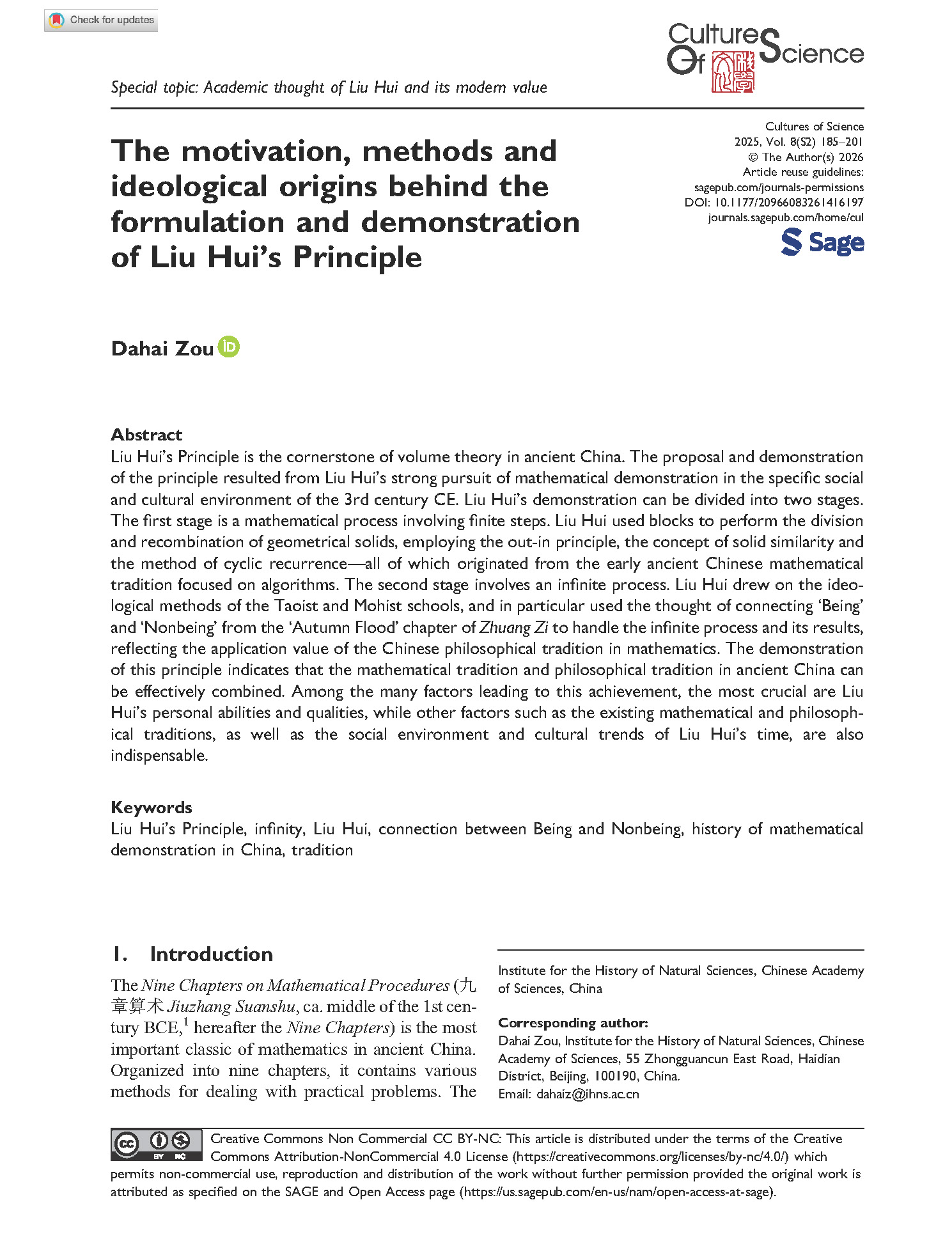
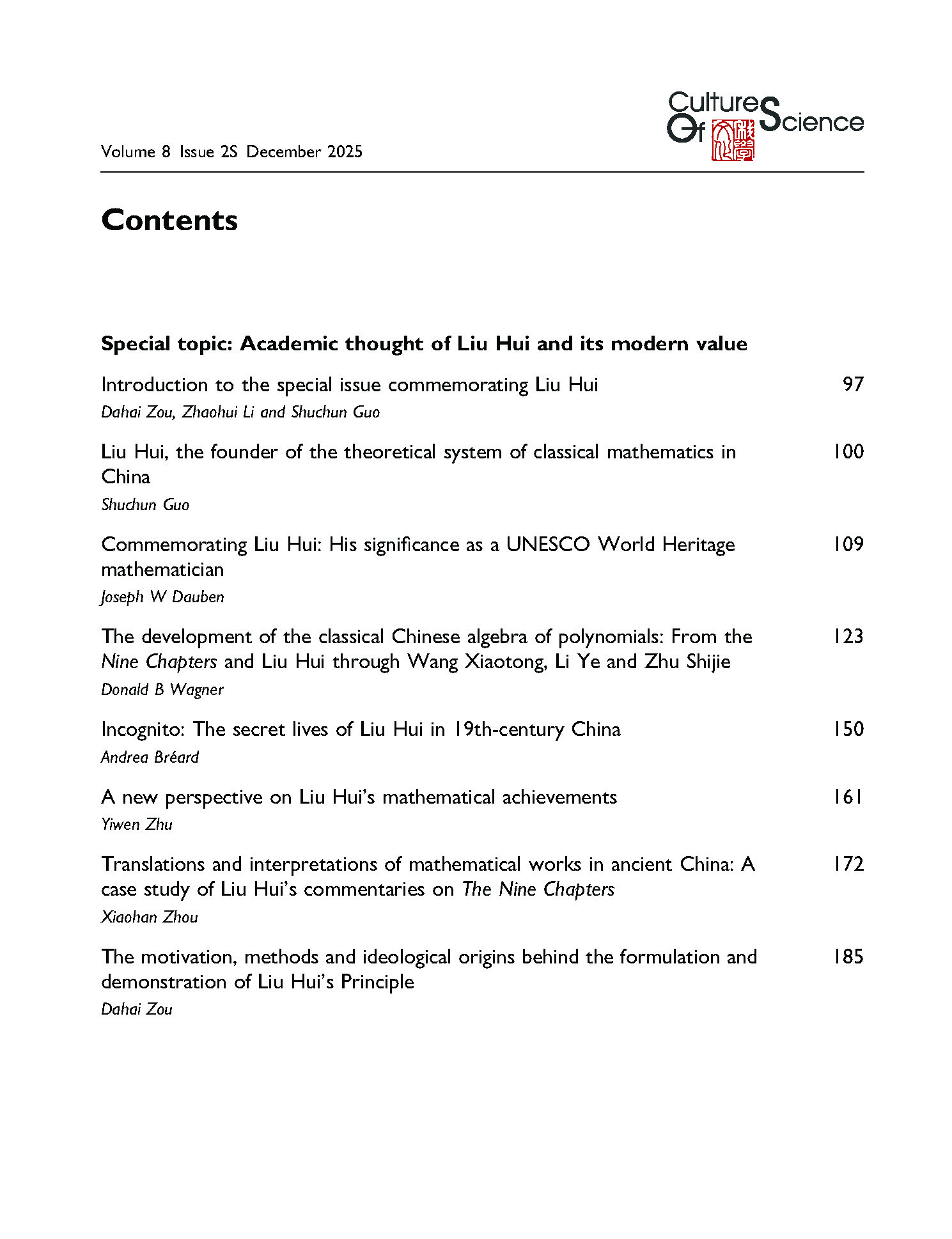
2023年11月,第42届联合国教科文组织大会审议通过了中国科协推荐的刘徽纪念系列活动,这是该组织审议通过的第一个中国科学家的系列纪念活动。中国科学院自然科学史研究所一直与中国科协科学技术传播中心协作,为国际刘徽纪念系列活动提供学术支持。在国内外多位学者和中国科协的英文期刊《科学文化》(Cultures of Science)的支持下,中国科学院自然科学史研究所与中国科协科学技术传播中心合作,组织出版了以“刘徽的学术思想及其现代价值(Academic thought of Liu Hui and its modern value)”为主题、包括7篇论文的专刊。现将专刊的目录、《纪念刘徽专刊导言》中文底版、英文版和各篇文章的首页刊布如下:
一、《科学文化》(Cultures of Science)“刘徽的学术思想及其现代价值”专刊目录
二、纪念刘徽专刊导言中文底版
邹大海1李朝晖2郭书春1
(1.中国科学院自然科学史研究所;2中国科协科学技术传播中心)
活动于公元3世纪的刘徽是中国古典数学的主要奠基人。他不仅是中国历史上最重要的数学家,而且在世界数学史上亦具有极为重要的地位。2023年11月,第42届联合国教科文组织大会审议通过了中国科学技术协会推荐的刘徽诞辰周年系列纪念活动,这是联合国教科文组织审议通过的第一个针对中国科学家的系列纪念活动。2024年9月23-27日“九章流徽——中国古典数学理论的主要奠基人刘徽专题展”在法国巴黎科德利埃空间(Réfectoire des Cordeliers)举办。2024年9月24日上午,在位于巴黎的联合国教科文组织总部举行了国际刘徽纪念系列活动的启动仪式。同日下午,“刘徽学术思想国际研讨会”在巴黎科德利埃空间举办。此后,有关纪念刘徽的展览、学术会议、学术和科普报告等系列活动在中国国内多个城市、韩国首尔、阿塞拜疆巴库、意大利罗马等地举行,彰显了刘徽在世界数学史上的贡献及其获得的国际认同。
2023年9月开始,中国科学院自然科学史研究所“十四·五”规划重大项目“中国科技传统及其现实意义研究”的负责人邹大海研究员领导的团队,一直积极与中国科协科学技术传播中心协作,为国际刘徽纪念系列活动提供学术支持。
在中国古代,数学虽然被认为是不可缺少的基础学科,但其社会地位一直不高,职业数学家极少,数学家地位的高低往往与其数学成就关系不大,而取决于其在政治、经济和文化上的影响,特别是与其官职的大小密切相关。刘徽虽然数学成就卓越,影响深远,但其社会地位不高,他于正史无传,各种文献中只有零星史料提及他的生平事迹。所幸他对《九章算术》的注释和他所撰写的《重差》(唐代以来称为《海岛算经》)成为隋唐以降国家数学制度的教科书,并保留至今,成为现代学者研究刘徽时所依靠的真凭实据。正是国际学术界从多个方位对刘徽开展的全面研究,尤其是20世纪八九十年代关于《九章算术》与刘徽研究的热潮,才使得刘徽受到国际上的认同,并使刘徽纪念系列活动建立在坚实的学理之上。当然,关于刘徽的研究并没有穷尽,总结已有研究成果,探索未知,提出和解决新的问题,仍是学术的应有之义。本专刊收录的7篇文章就是这方面的新成果。
中国科学院自然科学史研究所郭书春教授是刘徽研究领域最重要的代表人物。他的文章《刘徽——中国古典数学理论的奠基者》(“Liu Hui, the founder of the theoretical system of classical mathematics in China”)结合自己的研究经历,介绍了20世纪八九十年代刘徽研究的热潮,认为公元前1世纪的《九章算术》只是确定了中国古典数学的框架,而3世纪的刘徽则在魏晋时期辩难之风的影响下,对若干数学概念进行了定义,主要用演绎推理全面论证了《九章算术》算法的正确性,进而建立了中国古典数学的理论体系。文章还回顾了自己在严敦杰工作的基础上考证出刘徽是山东邹平人的研究结论。这些为今天的刘徽纪念活动提供了重要依据。
纽约市立大学教授道本周(Joseph W. Dauben)教授的论文《纪念刘徽——作为联合国教科文组织世界遗产数学家的重要意义》(“Commemorating Liu Hui: His Significance as a UNESCO World Heritage Mathematician”),对学术界关于刘徽的研究进行总结,在此基础展开自己的讨论。除中国学者的工作外,他尤其注重汲取其他国家学者研究刘徽的成果,从比较和交流的角度,指出刘徽成果的特征和他在世界数学史上的贡献和影响,肯定了刘徽“是一位具有超凡意义的先驱数学家”(“was a pioneering mathematician of outstanding significance”),一位“世界遗产数学家”(“World Heritage mathematician”)。他的论述彰显了刘徽在世界数学史上的地位和刘徽研究作为国际性学术研究领域的意义。
丹麦数学史家、哥本哈根大学华道安(Donald B. Wagner)教授的论文《中国古典多项式代数的发展——从〈九章算术〉和刘徽到王孝通、李冶和朱世杰》(“The development of the classical Chinese algebra of polynomials: From the Nine Chapters and Liu Hui through Wang Xiaotong, Li Ye and Zhu Shijie”)讨论中国古典多项式代数的发展,总结了现存文献所反映的这一历程中的一系列突破。他认为《九章算术》的开平方术和开立方术、刘徽所做的几何解释是这一历程的开端。这一研究把刘徽在开方问题上的工作置于历时性的发展历程之中,从而为刘徽对后世数学发展影响的研究提供了一个具体的案例。
德国爱尔兰根大学白安雅(Andrea Bréard)教授的论文《隐姓埋名——中国十九世纪刘徽隐踪》(“Incognito: The secret lives of Liu Hui in 19th-century China”)讨论了这样一个有趣的问题:到了清朝晚期,刘徽的名字已很少出现在当时的数学文献中,这是否意味着刘徽对19 世纪及之后的数学实践毫无影响?她通过考察数学家们使用的语言、论证结构与研究对象,表明刘徽的思想实际产生了持久的影响。她主张追溯植根于刘徽3世纪时为数学经典《九章算术》所作注疏的数学传承脉络与概念发展轨迹,挖掘中国古代数学知识潜在的“软实力”(“soft power”)。
中山大学哲学系朱一文教授的《关于刘徽数学成就的新视角》(“A new perspective on Liu Hui’s mathematical achievements”),关注前人已经讨论但仍不够充分的三个问题:一是刘徽关于中国早期数学发展的讨论,这深刻影响到中国数学文化基础的形成;二是刘徽对中国此后至13世纪持续发展的所谓“几何性代数”的贡献;三是刘徽在算筹使用方面的创新性理念与实践,而这是13世纪中国数学文本化与符号化进程的早期先驱。他还主张,应该结合刘徽与当时的政治权力和哲学思想之间的互动,来理解他的成就。
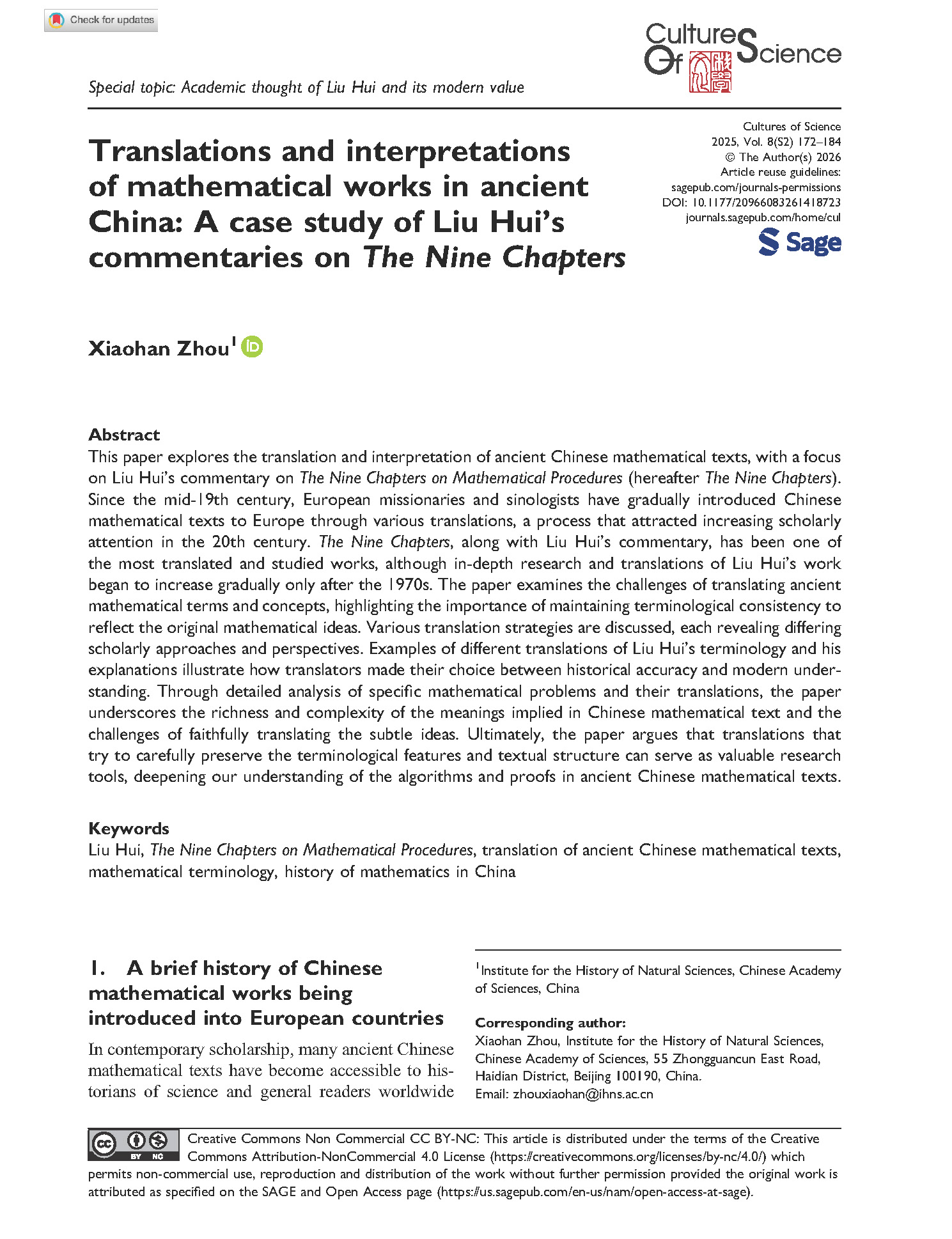
中国科学院自然科学史研究所周霄汉教授的《中国古代数学著作的翻译与阐释——以刘徽对〈九章算术〉的注释为案例的研究》(“Translations and interpretations of mathematical works in ancient China: A case study of Liu Hui’s commentaries on The Nine Chapters”)回顾了19世纪中叶以来欧洲来华传教士和汉学家对中国数学的翻译与引入,认为《九章算术》及其刘徽注是长期以来一直关注的重点,而忠实传递古代学者的精妙思想是研究者所面临的挑战。作者强调术语的一致性和忠实保存原始的数学结构对传递原著的数学思想至关重要,并说明译者应如何在历史的准确性与现代的可读性之间达成平衡。
中国科学院自然科学史研究所邹大海教授的《刘徽原理之提出和证明的动机、方法和思想渊源》(“The motivation, methods, and ideological origins behind the formulation and demonstration of Liu Hui’s Principle”)认为刘徽原理的提出与刘徽在所处时代中形成的强烈证明意识有密切的关系。这一原理的证明是将中国的算法传统和哲学传统进行创新性应用和有机结合的产物,而实现这种结合与诸多因素的协同作用有关,但其中最重要者当属刘徽的个人能力和素质。
上述7篇文章,既有宏观上的讨论,也有在某一特定主题上的深入探讨,它们涉及了刘徽的生平、学术成就、思想渊源、历史影响和创新思维等诸多方面。可以相信,它们将为今后的刘徽研究注入新的活力,也为刘徽的深邃思想和科学遗产在新时代的传播与发扬提供学术基础和推动力。
三、纪念刘徽专刊导言英文版
Introduction to the special issue commemorating Liu Hui
Dahai Zou1,ZhaohuiLi2and ShuchunGuo1
1 Institute for the History of Natural Sciences, Chinese Academy of Sciences, China
2 National Communication Center for Science and Technology, CAST, China
Corresponding author:
Dahai Zou, Institute for the History of Natural Science, Chinese Academy of Sciences, 55 Zhongguancun East Road, Haidian District, Beijing 100190, China.
Email: dahaiz@ihns.ac.cn
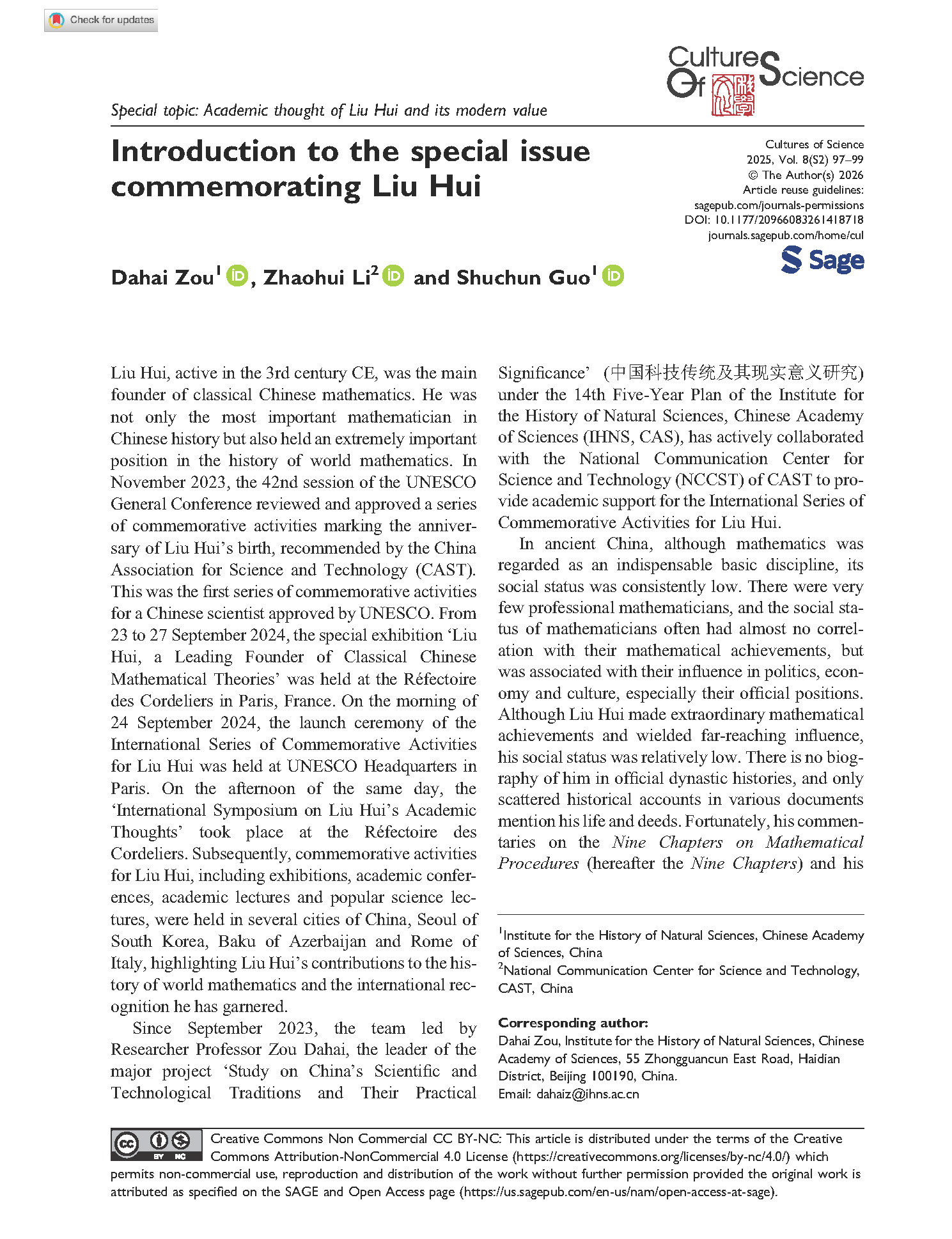
Liu Hui, active in the 3rd century CE, was the main founder of classical Chinese mathematics. He was not only the most important mathematician in Chinese history but also held an extremely important position in the history of world mathematics. In November 2023, the 42nd session of the UNESCO General Conference reviewed and approved a series of commemorative activities marking the anniversary of Liu Hui’s birth, recommended by the China Association for Science and Technology (CAST). This was the first series of commemorative activities for a Chinese scientist approved by UNESCO. From 23 to 27September 2024, the special exhibition ‘Liu Hui, a Leading Founder of Classical Chinese Mathematical Theories’ was held at the Réfectoire des Cordeliers in Paris, France. On the morning of 24September 2024, the launch ceremony of the International Series of Commemorative Activities for Liu Hui was held at UNESCO Headquarters in Paris. On the afternoon of the same day, the ‘International Symposium on Liu Hui’s Academic Thoughts’ took place at the Réfectoire des Cordeliers. Subsequently, commemorative activities for Liu Hui, including exhibitions, academic conferences, academic lectures and popular science lectures, were held in several cities of China, Seoul of South Korea, Baku of Azerbaijan and Rome of Italy, highlighting Liu Hui’s contributions to the history of world mathematics and the international recognition he has garnered.
Since September 2023, the team led by Researcher Professor Zou Dahai, the leader of the major project ‘Study on China’s Scientific and Technological Traditions of and Their Practical Significance’ (中国科技传统及其现实意义研究) under the 14th Five-Year Plan of the Institute for the History of Natural Sciences, Chinese Academy of Sciences (IHNS, CAS), has actively collaborated with the National Communication Center for Science and Technology (NCCST), CAST, to provide academic support for the International Series of Commemorative Activities for Liu Hui.
In ancient China, although mathematics was regarded as an indispensable basic discipline, its social status was consistently low. There were very few professional mathematicians, and the social status of mathematicians often had almost no correlation with their mathematical achievements, but was associated with their influence in politics, economy and culture, especially their official positions. Although Liu Hui made extraordinary mathematical achievements and wielded far-reaching influence, his social status was relatively low. There is no biography of him in official dynastic histories, and only scattered historical accounts in various documents mention his life and deeds. Fortunately, his commentaries onthe Nine Chapters on Mathematical Procedures(hereafter the Nine Chapters) and his workChongcha(later known asSea Island Mathematical Classicsince the Tang Dynasty) became textbooks in the national mathematical education system from the Sui and Tang dynasties onwards and have been preserved to the present, serving as credible evidence for modern scholars studying Liu Hui. It is precisely the comprehensive and multifaceted research on Liu Hui conducted by the international academic community, especially the upsurge of research on the Nine Chapters and Liu Hui in the 1980s and 1990s, that has enabled him to gain international recognition and grounded the series of commemorative activities dedicated to him on a solid academic foundation. Naturally, research on Liu Hui is far from exhaustive; summarizing existing research results, exploring the unknown, and proposing and solving new problems remain inherent responsibilities of academia. The seven articles we solicited and included in this special issue are new achievements in this regard.
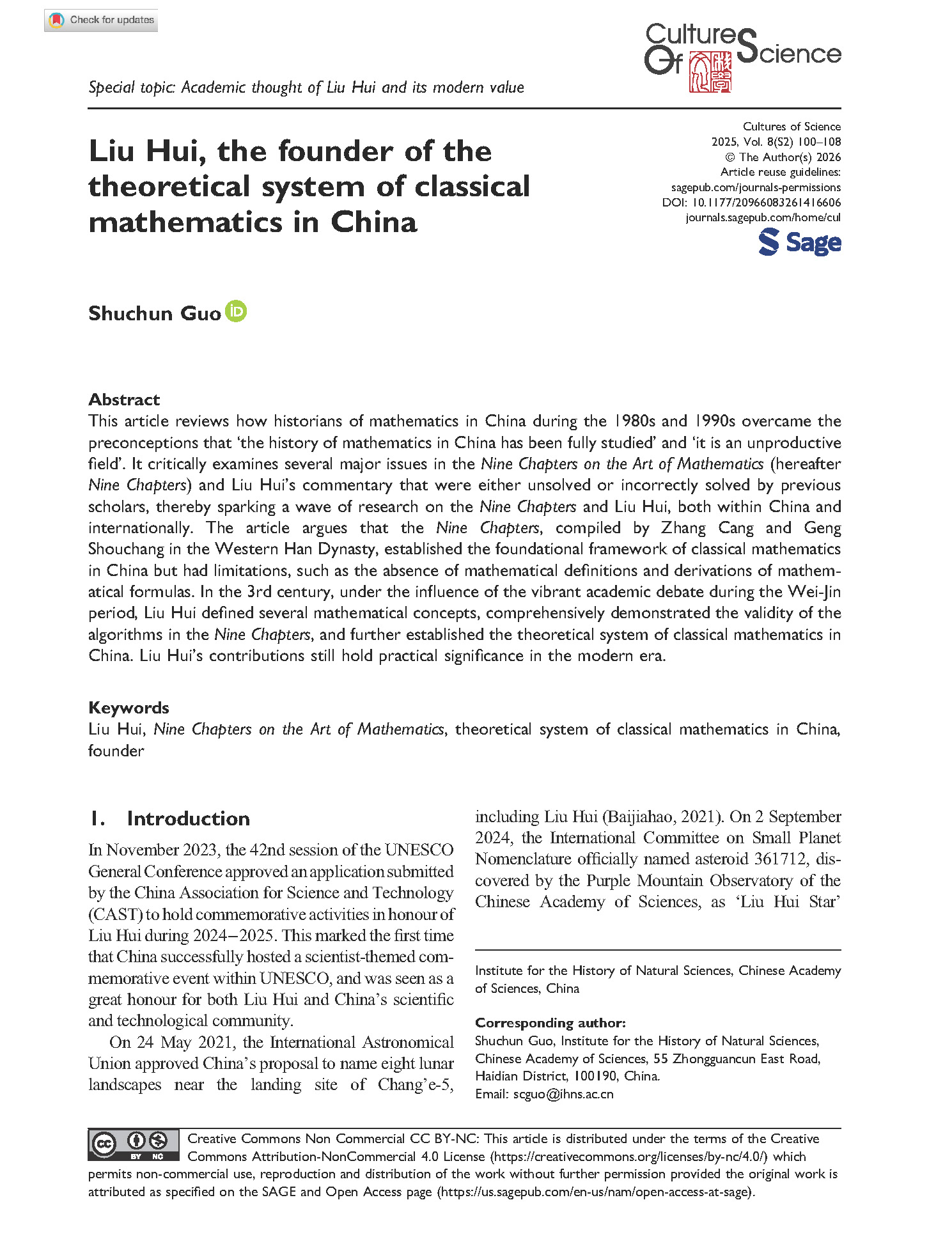
Professor Guo Shuchun from IHNS of CAS is the most important representative in the field of Liu Hui studies. His article ‘Liu Hui, the founder of the theoretical system of classical mathematics in China’ combines his own research experience to introduce the upsurge of Liu Hui studies in the 1980s and 1990s. He argues thatthe Nine Chapters compiled in the 1st century BCE only established the framework of classical Chinese mathematics, while Liu Hui in the 3rd century, influenced by the ethos of academic debate during the Wei and Jin dynasties, defined some mathematical concepts, comprehensively demonstrated the correctness of the algorithms inthe Nine Chaptersmainly through deductive reasoning, and thus established the theoretical system of classical mathematics in China. He also reviews how, he, on the basis of Yan Dunjie’s research, reached the conclusion that Liu Hui was from Zouping, Shandong Province. These have provided important foundations for today’s commemorative activities for Liu Hui.
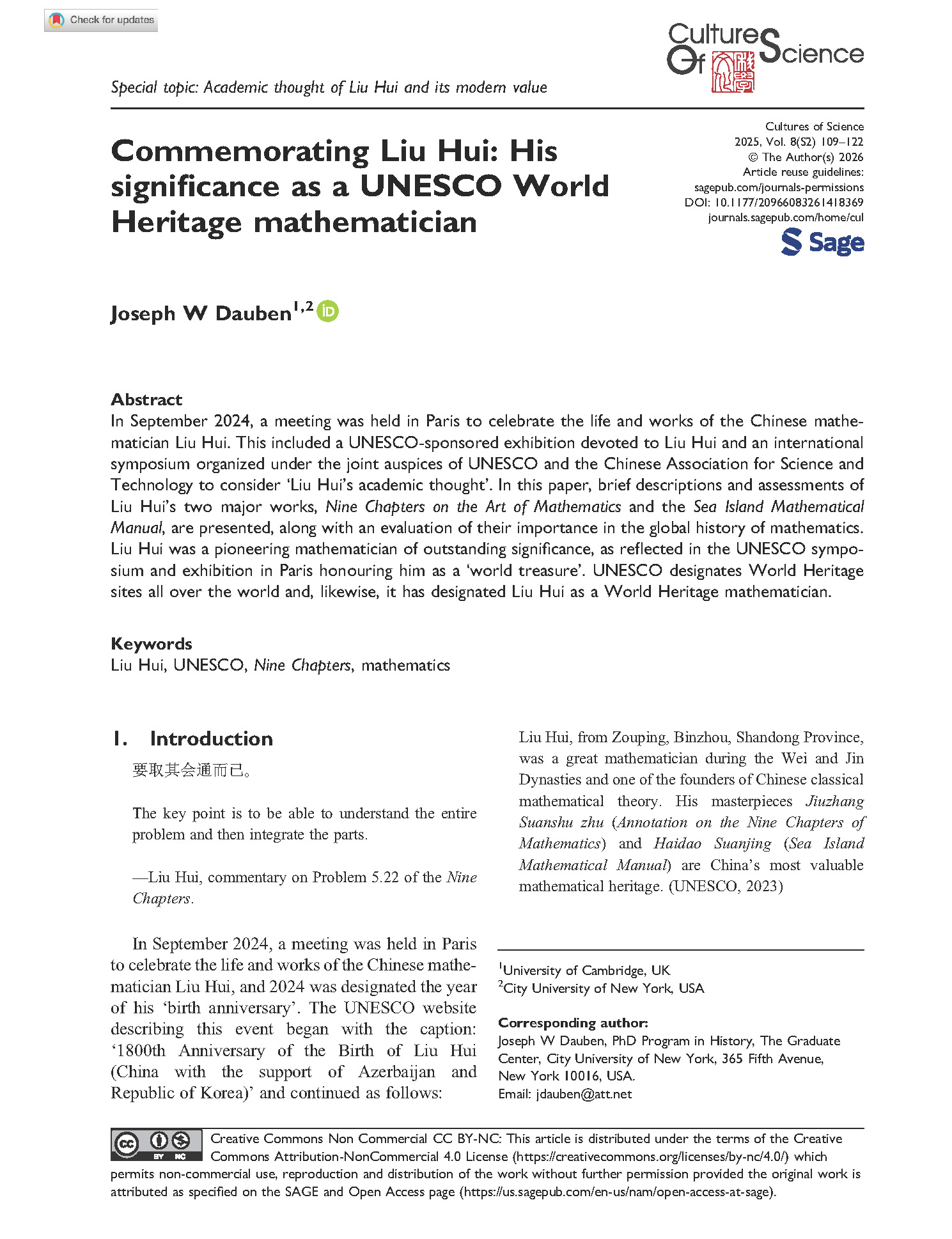
Professor Joseph W Dauben, at the City University of New York, presents his paper‘Commemorating Liu Hui: His significance as a UNESCO World Heritage mathematician’, which summarizes academic research on Liu Hui and develops his own discussions on this basis. In addition to the work of Chinese scholars, he pays special attention to absorbing the research achievements of scholars from other countries on Liu Hui. From the perspective of comparison and exchange, he points out the characteristics of Liu Hui’s achievements as well as his contributions and influence in the history of world mathematics, affirming that Liu Hui ‘was a pioneering mathematician of outstanding significance’ and a ‘World Heritage mathematician’.His discussions highlight Liu Hui’s status in the history of world mathematics and the significance of Liu Hui studies as an international academic research field.
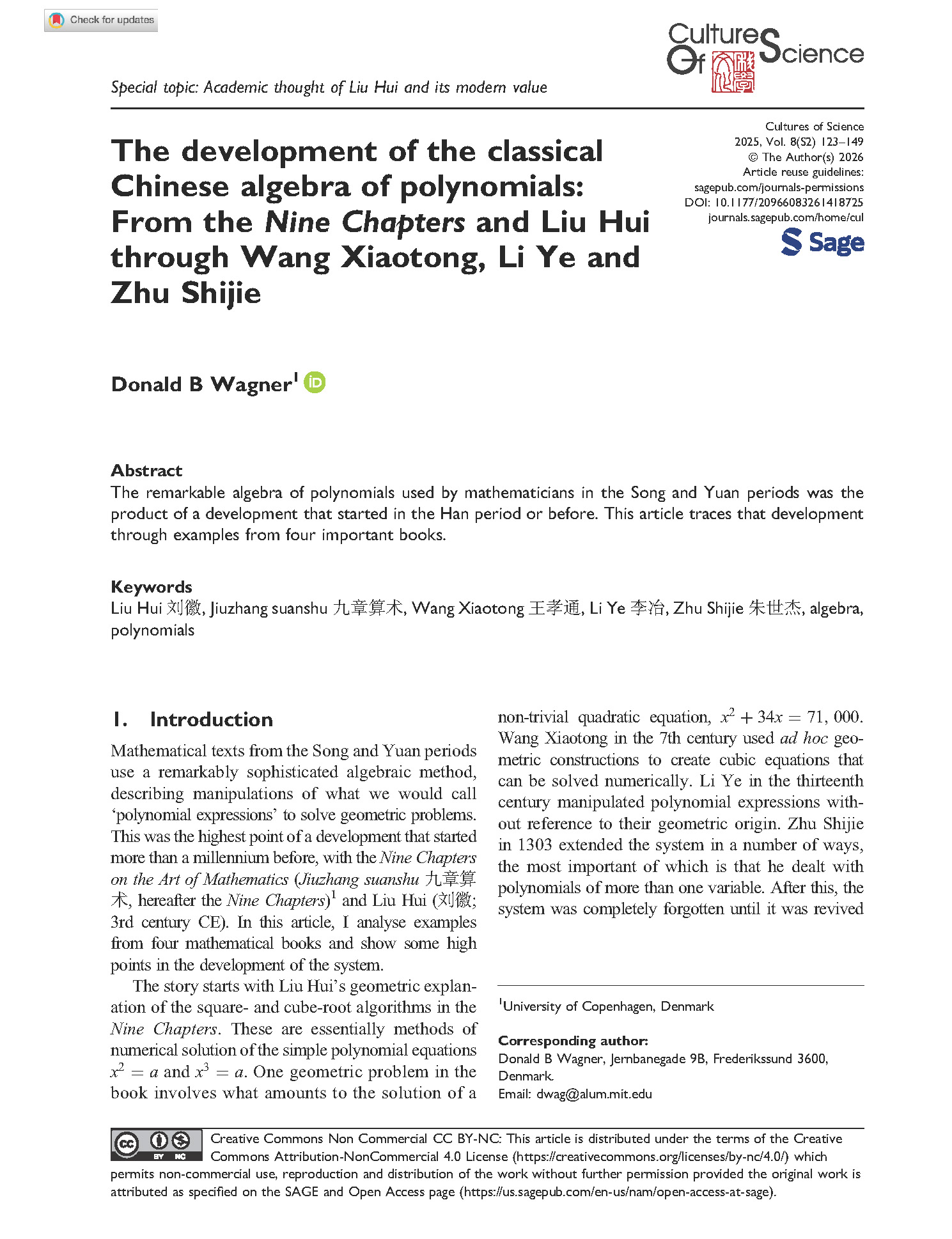
Professor Donald B Wagner from the University of Copenhagen contributes his paper‘The development of the classical Chinese algebra of polynomials: From the Nine Chapters and Liu Hui through Wang Xiaotong, Li Ye and Zhu Shijie’, which discusses the development of classical Chinese polynomial algebra. He summarizes a series of breakthroughs in this process reflected in existing documents and argues that the square-root extraction and cube-root extraction methods inthe Nine Chapters, along with Liu Hui’s geometric interpretations, marked the beginning of this journey. This study places Liu Hui’s work on root extraction within a diachronic developmental context, thereby providing a specific case study of Liu Hui’s influence on the development of mathematics in subsequent generations.
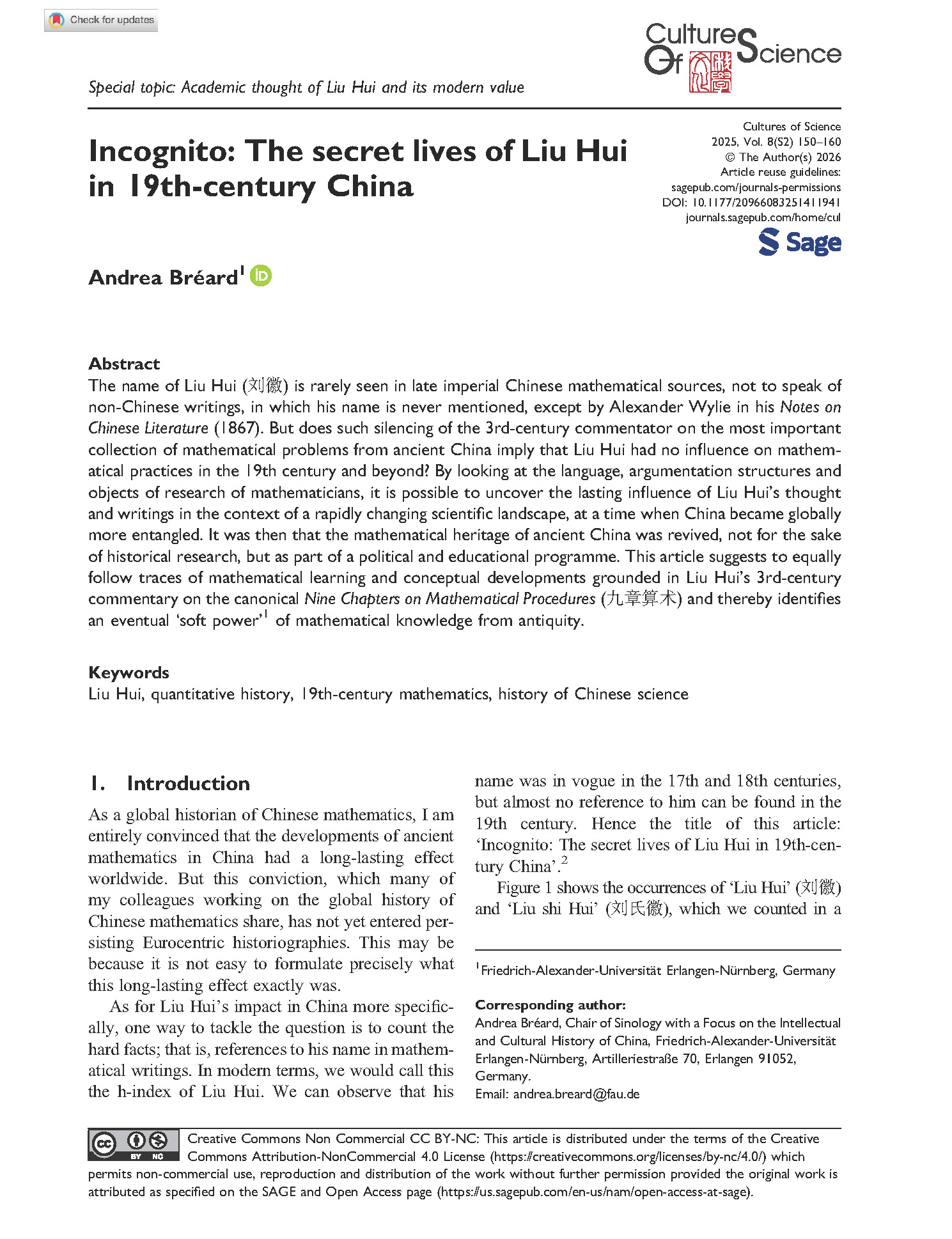
Professor Andrea Bréard from the Friedrich-Alexander-Universität Erlangen-Nürnberg presents her paper‘Incognito: The secret lives of Liu Hui in 19th-century China’, which explores an interesting question: In the late Qing Dynasty, Liu Hui’s name rarely appeared in mathematical documents of the time—did this mean that Liu Hui had no influence on mathematical practice in the 19th century and beyond? By examining the language, argumentative structures and research objects used by mathematicians, she demonstrates that Liu Hui’s ideas actually exerted a lasting influence. She advocates tracing the context of mathematical inheritance and the trajectory of conceptual development rooted in Liu Hui’s commentaries on the Nine Chaptersin the 3rd century, and exploring the potential ‘soft power’ of ancient Chinese mathematical knowledge.
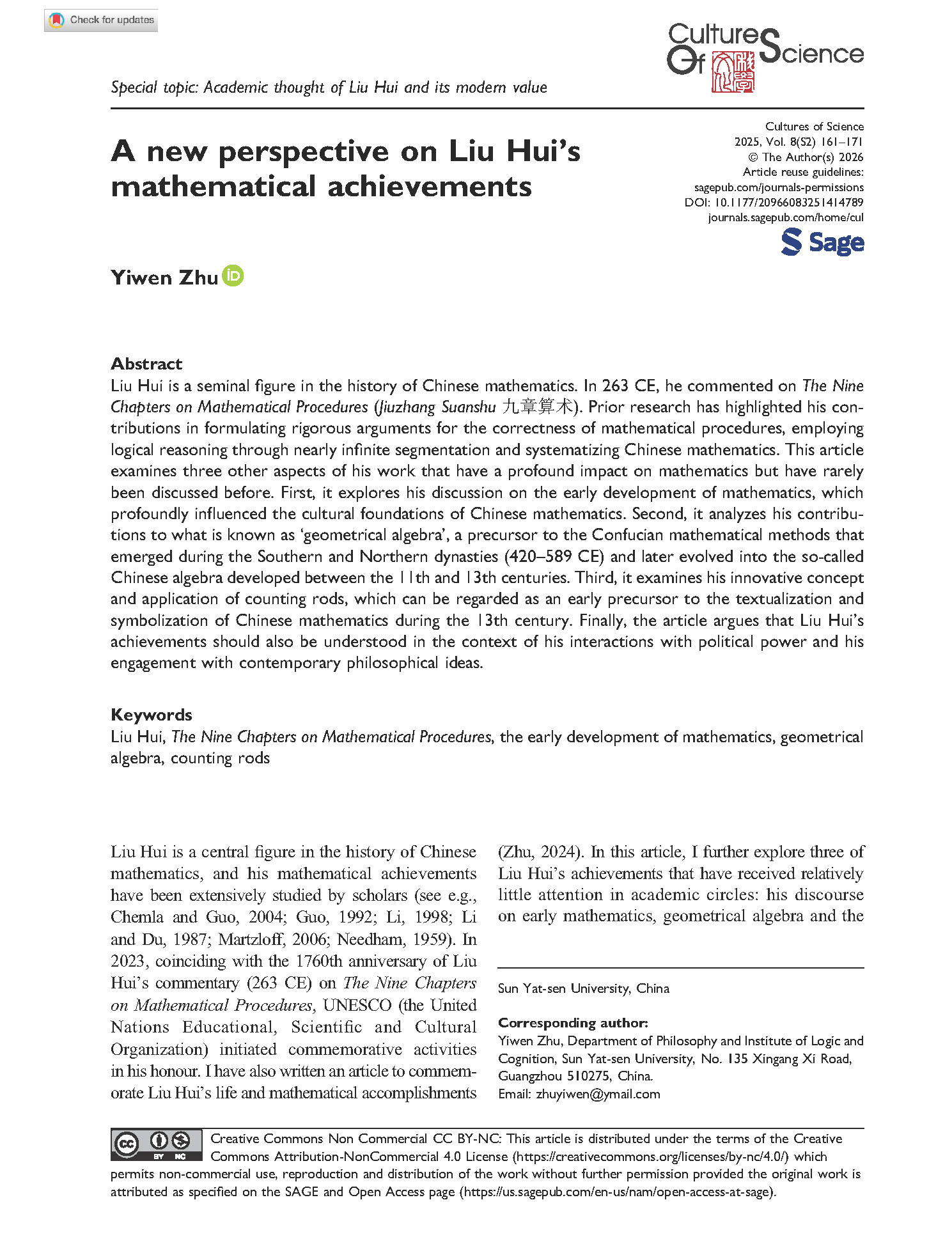
Professor Zhu Yiwen from the Department of Philosophy of Sun Yat-sen University offers his paper‘A new perspective on Liu Hui’s mathematical achievements’, which focuses on three issues that have been discussed by previous scholars but remain insufficiently explored. First, Liu Hui’s discussions on the early development of Chinese mathematics, which profoundly shaped the foundation of Chinese mathematical culture. Second, Liu Hui’s contributions to the so-called ‘geometric algebra’ that continued to develop in China until the 13th century. Third, Liu Hui’s innovative ideas and practices regarding the use of counting rods, which were early precursors to the textualization and symbolization of Chinese mathematics in the 13th century. He also argues that Liu Hui’s achievements should be understood in the context of his interactions with the political power and philosophical thought of his time.
Professor Zhou Xiaohan from IHNS of CAS presents his paper‘Translations and interpretations of mathematical works in ancient China: A case study of Liu Hui’s commentaries on the Nine Chapters’, which reviews the translation and introduction of Chinese mathematics by European missionaries and sinologists in China since the mid-19th century. He argues thatthe Nine Chaptersand Liu Hui’s commentary on it have been a long-term focus of attention, and that faithfully conveying the profound ideas of ancient scholars is a challenge faced by researchers. He emphasizes that the consistency of terminology and the faithful preservation of original mathematical structures are crucial for conveying the mathematical ideas of the original works, and explains how translators should strike a balance between historical accuracy and modern readability.
Professor Zou Dahai from IHNS of CAS contributes his paper‘The motivation, methods and ideological origins behind the formulation and demonstration of the Liu Hui Principle’, which argues that the proposal of Liu Hui’s Principle is closely related to the strong awareness of proof formed by Liu Hui in his era. He notes that the demonstration of this principle is the result of the innovative application and organic integration of China’s algorithmic tradition and philosophical tradition. The achievement of this integration is related to the synergy of various factors, but the most important among them is Liu Hui’s personal abilities and qualities.
The above seven articles include both macro-level discussions and in-depth explorations of specific themes, covering various aspects such as Liu Hui’s life, academic achievements, ideological origins, historical influence and innovative thinking. It is believed that they will inject new vitality into future Liu Hui studies and provide an academic foundation and driving force for the dissemination and promotion of Liu Hui’s profound ideas and scientific legacy in the new era.
Author biography
DahaiZou is a research professor of the Institute for the History of Natural Sciences, Chinese Academy of Sciences. His research interests include the history of mathematics in China and the history of traditional Chinese scientific thought.
Zhaohui Li is an associate research professor at the National Communication Center for Science and Technology, CAST. His research interests include science communication and science popularization.
Shuchun Guo is a research professor at theInstitute for the History of Natural Sciences, Chinese Academy of Sciences. His research interest is in the history of Chinese mathematics.
四、纪念刘徽专刊各篇文章首页
1.邹大海、李朝晖、郭书春《刘徽纪念专刊导言》首页
2.郭书春《刘徽——中国古典数学理论的奠基者》首页
3.道本周《纪念刘徽——作为联合国教科文组织世界遗产数学家的重要意义》首页
4.华道安《中国古典多项式代数的发展——从〈九章算术〉和刘徽到王孝通、李冶和朱世杰》首页
5.白安雅《隐姓埋名——中国十九世纪刘徽隐踪》首页
6.朱一文《关于刘徽数学成就的新视角》首页
7.周霄汉《中国古代数学著作的翻译与阐释——以刘徽对〈九章算术〉的注释为案例的研究》首页
8.邹大海《刘徽原理之提出和证明的动机、方法和思想渊源》首页