Futuring Biological Commons: Ethics , Plurality , and the Cosmopolitics of Science
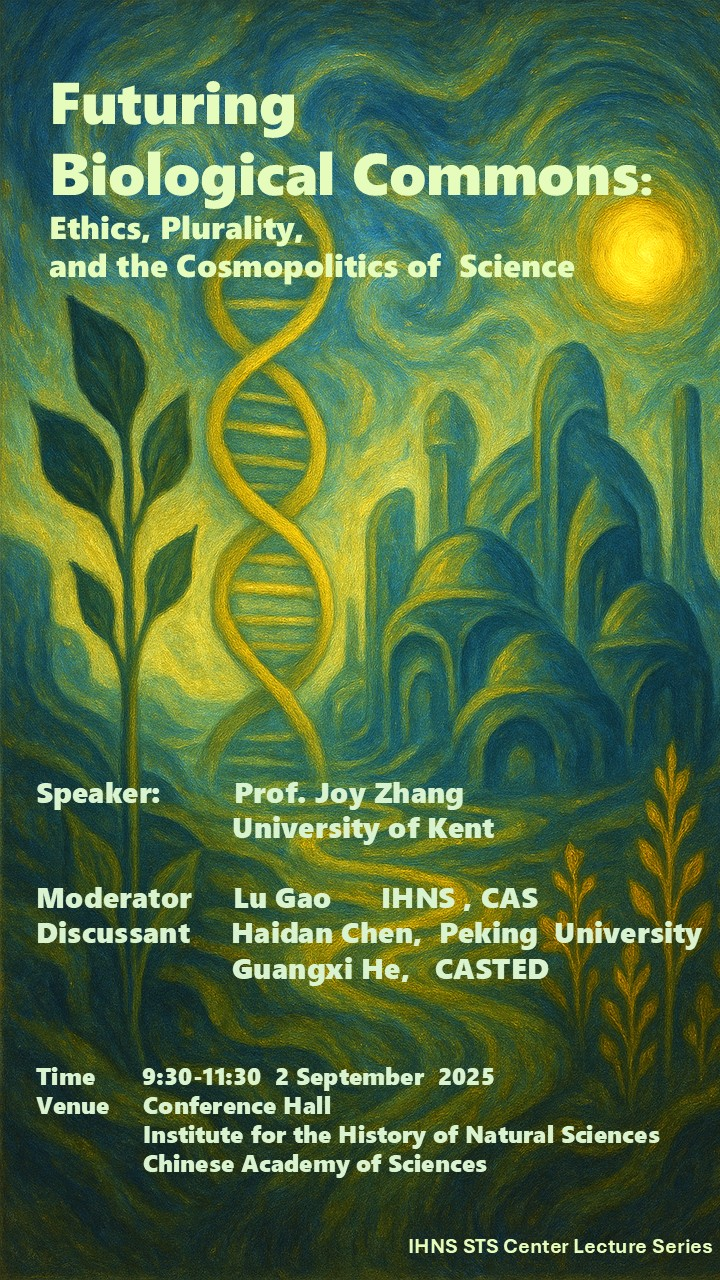
报告人: Joy Zhang英国肯特大学
主持人: 高 璐 中国科学院自然科学史研究所
评议人: 陈海丹 北京大学医学与人文研究院
何光喜 中国科学技术发展战略研究院
时 间: 2025年9月2日(星期二) 9:30-11:30
地 点: 中国科学院自然科学史研究所 学术报告厅
主 办: 中国科学院自然科学史研究所科技与社会研究中心
报告人介绍:Joy Y. Zhang is Professor of Sociology and the Founding Director of the Centre for Global Science and Epistemic Justice (GSEJ) at the University of Kent. An internationally recognised expert in the transnational governance of scientific risk, she specialises in emerging life sciences that impact both human and environmental futures. Her work advances sociological thinking on risk, cosmopolitanism, decolonisation, and subaltern politics. Zhang has initiated several landmark programmes, including the BioGovernance Commons in 2021, the founding of GSEJ in 2022, and, most recently, O.D.E.SS.I.—a global ‘odyssey’ for life sciences governance that brings together public engagement and science diplomacy. Since its inception, GSEJ has convened events with participants from 24 countries, including co-hosting a UK–India G20 meeting on biogovernance and science diplomacy in New Delhi. Zhang’s policy recommendations on global biodata governance were featured in the 2024 Think7 communiqué presented to the G7 presidency. She is the author of three academic books and publishes widely in high-impact journals across both the natural and social sciences. She is frequently interviewed by global media and advises leading research and policy institutions in Europe and Asia.
内容简介:This talk invites a rethinking of socio-ethical engagement in science—not as a checklist of fixed rules, but as a dynamic, collective process of shaping the future. While social scientists have long championed the role of socio-technical imaginaries in guiding innovation, these imaginaries are often flattened in global discourse, reduced to rival visions competing for dominance. Inspired by Elinor Ostrom’s notion of ‘commoning,’ I propose an alternative approach—one that treats ethics as a socio-political vision and prioritises the cultivation of ethical social relations across borders.
This perspective is grounded in Futuring Biological Commons ,a research programme I lead ,funded by ARIA (the UK未配对的括号或引号!s Advanced Research and Invention Agency) ,which supports high-risk ,high-reward scientific research. Here ,I treat ‘futuring’ as both a noun and a verb: it refers not only to the prospects for life on Earth ,but also to the active shaping of those futures through the hopes and actions that orient us toward particular socio-technical pathways. As many ethicists have rightly argued ,plant ethics must evolve to address synthetic biology and genetic engineering. More importantly ,we need a bioethics that embraces the complexities of innovation and diverse social systems—one capable of nurturing ‘caring relationships’ between ecosystems ,soil ,animals ,and the communities that depend on them.
In this light ,the talk calls for a cosmopolitics of science: one grounded not in consensus ,but in respectful plurality ,enabling diverse communities to collaboratively navigate the promises and uncertainties of emerging biotechnologies.